Small, useful tools for Second Life.
From the Greek agalma — a thing of delight, given freely.

Small, useful tools for Second Life.
From the Greek agalma — a thing of delight, given freely.
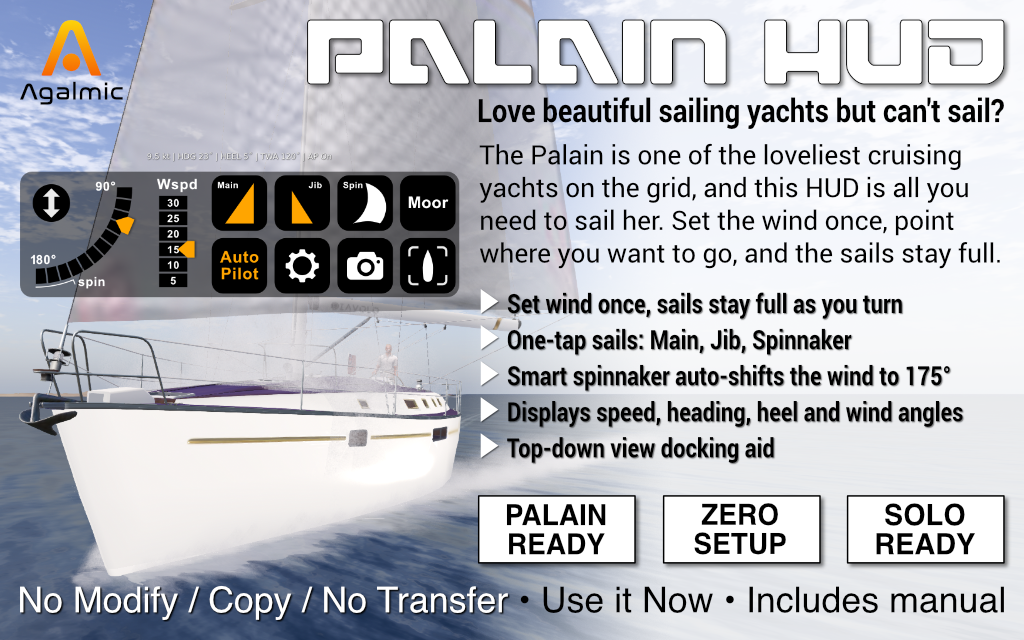
Sail her like she's yours.
The Palain HUD puts everything you need to sail her onto one neatly organised panel — sails, wind, autopilot, a top-down docking view and live telemetry. Nothing you don't need, nothing in the way. She's built for the easy days: leisurely afternoons, sunset cruises, and single-handing for the joy of it.
Most SL wind systems set the wind in world terms — south-westerly at fifteen knots — and shift on you the moment you turn, so the sails need re-trimming every time. The Palain HUD works the other way round. You set the wind angle relative to your bow, and the HUD holds that angle locked as you steer. Point the bow where you want to go and the sails stay full — sail to your destination in a straight line if you like.
The autopilot does the trimming. Raise your first sail and it engages a moment later; drop your last and it lets go. To steer by hand, set the wind, tap Auto Pilot once to trim, then tap it off — the sails stay set and stay trimmed however you turn. You only re-trim when you change something deliberately: a new wind angle, a big shift in speed, or a sail going up or down.
The Palain carries three sails — Main, Jib and Spinnaker — each on its own button, with the headsail swap handled for you. Raise the spinnaker and the wind swings aft to suit the kite automatically. A top-down camera squares you up for docking, and live boat data floats above the HUD — speed, heading, heel, wind angle and autopilot state — refreshed every second.
Set the angle once on the arc; the HUD recomputes world wind as you turn. Sails stay full at every heading.
Engages a moment after your first sail is up; releases when the last comes down. Tap to override and free-steer any time.
Main, Jib and Spinnaker, each on its own button. The Palain flies one headsail at a time, so the HUD swaps jib and kite for you.
Raise the kite and the wind swings to 175° — almost dead aft, where it draws best. Bring the wind too tight and the HUD drops it before the bow goes under.
Tap Track for a near-plan view from above. See exactly where your hull sits against the pier instead of guessing from the chase cam.
Been wandering the cabin or using the leisure animations? Tap Cam to snap your view straight back to the helm.
Speed, heading, heel, true wind angle and autopilot state float above the HUD — refreshed about once a second.
If a button drifts out of step with the boat, hold it a quarter-second — it flashes green and flips state without sending a command.
Hover or tap a marker to see what each control does, then read the full reference below.
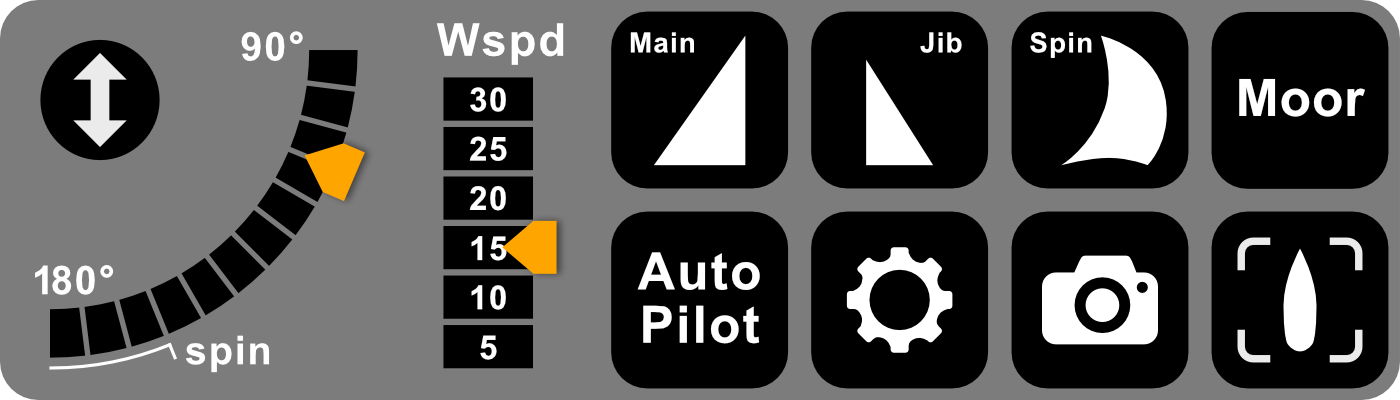
The Palain HUD panel. Marker positions are a guide — the labels on the HUD itself are the reference.
The double-arrow button slides the whole HUD off-screen when you want an uncluttered view of the water, and brings it back with another tap. It stays reachable even while the HUD is hidden, alongside the Track button, so the panel is never more than a tap away. The hover text clears while hidden so nothing floats alone in mid-air.
A 90°–180° arc covering the downwind half of the wind circle. The orange tab marks where the wind sits relative to your bow: 90° is a beam reach (wind on the side), 135° a broad reach, 180° a dead run. Tap anywhere on the arc and the tab slides to the new angle; the HUD recomputes the world wind and sends it to the boat.
Six wind speeds in knots, top to bottom: 30, 25, 21, 15, 8, 1 — the standard TMS / BOSS extended set. Tap a value and it glows orange. The 1 setting sends a near-calm breeze, handy for slowing the boat before a mooring.
Raises or lowers the mainsail. Lit when up. Give each sail a moment to finish its animation before sending the next command.
The smaller, all-conditions headsail. One tap up, one tap down. Lit when up. The Palain flies one headsail at a time — see Spinnaker for how the swap works.
The downwind balloon. Because the Palain flies only one headsail at a time, raising the spinnaker while the jib is up drops the jib first, then hoists the kite about seven seconds later once the animation finishes — the destination button lights immediately so you know the swap is in flight. Raising the spinnaker also snaps the wind to 175° (almost dead aft); dropping it snaps back to 120° (broad reach) for the working sails.
A single-tap return to her moored state: lowers all sails, releases the autopilot and stops the engine in one go. The HUD updates every button to match. Use it at your mooring to finish the sail cleanly.
Trims the sails to the wind and holds them there as you turn. Engages itself a moment after your first sail goes up and releases when the last comes down. Lit while on. Tap to override — raise the sails to let it trim, then tap it off to free-steer with the sails locked. The Palain whispers its autopilot state on chat and the HUD listens, so the button stays in sync even if you toggle it from the boat's own menu.
Snaps your camera back to the default sailing view — useful after the leisure animations or a wander round the cabin have left it drifting. A one-shot button: a single tap, no on/off state.
Starts and stops the motor for leaving the dock and low-speed manoeuvring. Lit while running. Throttle with E, C or Page Up / Page Down once started.
Switches your view to a bird's-eye shot looking straight down on the boat. From above you can read exactly where your hull sits relative to the pier, far easier than guessing from the chase camera. Tap again to return. The camera is a viewer-side feature, so Track works whether or not the HUD is hidden.
The hover text above the HUD shows live boat data, refreshed about once a second: speed in knots, heading, heel angle, the true wind angle you've set on the arc, and the autopilot state. It appears only while the Palain Heading Broadcast script is running in your boat — if you don't see it, check the script is in the boat's contents.
If the HUD's idea of a control ever drifts from the boat's actual state — say you raised a sail from the boat's own menu — long-press the affected button for a quarter-second. It flashes green to confirm, then flips its colour on release without sending any command, bringing the HUD back into step with reality. Long-press works on Main, Jib, Spin, Auto Pilot and Engine.
The Palain HUD is purpose-built for the Palain, a cruising yacht by The Mesh Shop. It speaks to the boat on the standard TMS sailing channel (29000) using the BOSS 3rd-generation engine command set, and listens for telemetry on a private broadcast channel.
Organised SL races use enforced event wind set by race buoys, which override personal wind HUDs — so the Palain HUD is for private sailing rather than club racing. Leisurely afternoons, sunset runs out to the islands, and single-handing for the joy of it.
The package includes the Palain HUD, the Palain Heading Broadcast script and a notecard guide. Questions or issues? IM Joshua Lit in-world — most things are quick to sort with a short test.